
In Memoriam
Professor Emeritus David A. Chappell · University of Hawaiʻi at Mānoa
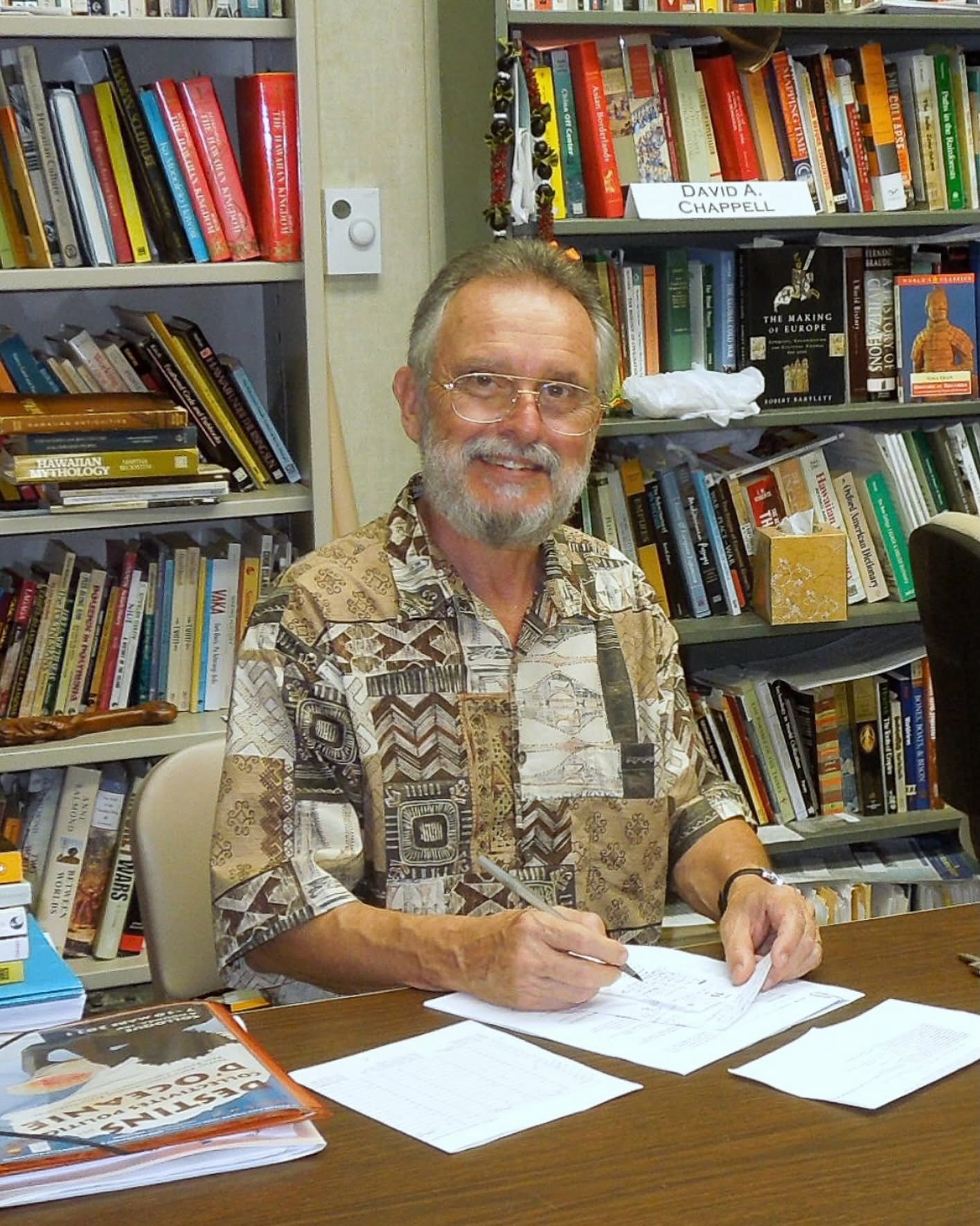
Who is your “rock star” historian? I discovered a “rock star” historian when I first read the works of Dr. David A. Chappell. I call him my “rock star” historian because I was astonished when I first read his book, Double Ghosts: Oceanian Voyagers on Euroamerican Ships (New York: M.E. Sharpe, 1997). He was one of the only historians in the field looking at the deep connections between and among the voyagers of the Pacific. He followed the voyagers as if you were on the ships with them and provided detail from ships’ logs that could only be found from copious research and familiarity with materials across libraries and archives.
Dr. Chappell became my “rock star” historian when I decided to return to graduate school at the age of 46 at CSU, Northridge in 2009. My mentor at CSUN suggested I email Dr. Chappell at the University of Hawaiʻi, Mānoa and ask him about further references for my MA thesis research. To my amazement, Dr. Chappell responded to my email within a day or two. When I received the email, I was flummoxed! He was a famous historian who took a minute to send me a few words of encouragement and further sent information on possible sources to investigate. I was breathless! I just sat and looked at the email for hours, too afraid to even close the email or make a mistake in my response. In later years, I would joke it was like getting an email from Keith Richards. If you don’t know Keith Richards, I encourage you now to look up the Rolling Stones and the song “Gimme Shelter”. Go ahead…I will wait. You can do it! You are historians!
I have never forgotten the kindness he showed me. It changed my life and his work continues to affect the lives of students and teachers alike; he was that kind of “rock star”. What is more, Dr. Chappell was a steadfast supporter of Phi Alpha Theta. It is with great sadness, then, that I must tell you that Professor Emeritus David A. Chappell passed away on May 14, 2026, following a battle with lymphoma. This announcement is not meant to be an obituary, but rather a tribute to the personal ways that one history professor can impact the lives of generations. Furthermore, this serves to remind the many mentors and students of Phi Alpha Theta the ways this community of historians impacts the world. Our work here resembles the waves of the Pacific, rippling across vast distances and landing on many shores.
After my MA work, I was fortunate enough to be accepted to the University of Hawaiʻi, Mānoa for my doctoral studies and meet Dr. Chappell in person. That was another “rock star” moment! I was introduced to the discipline of Pacific History and the classes of both Dr. Chappell and Dr. David Hanlon. They taught students new approaches to a much-neglected branch of our world history. As if studying with my “rock star” historian was not enough, I was soon assigned to serve as his Graduate Teaching Assistant for two semesters. I was a little scared, and at the same time thrilled that I would get to learn from his lectures. I dared not miss a deadline! And I hoped to regale him when he visited my lab lectures. Yep. It was still like having a “rock star” visit my classes. Additionally, I regularly used his article in my own classes: “Shipboard Relations Between Pacific Island Women and Euroamerican Men 1767-1887.” Journal of Pacific History 27.2 (Dec., 1992): 131-149. It was an eye-opener for many students!
“I won prizes presenting papers at Phi Alpha Theta history honor society graduate student conferences.”
Dr. David A. Chappell, Serendipity: Experience of Pacific Historians (2024)
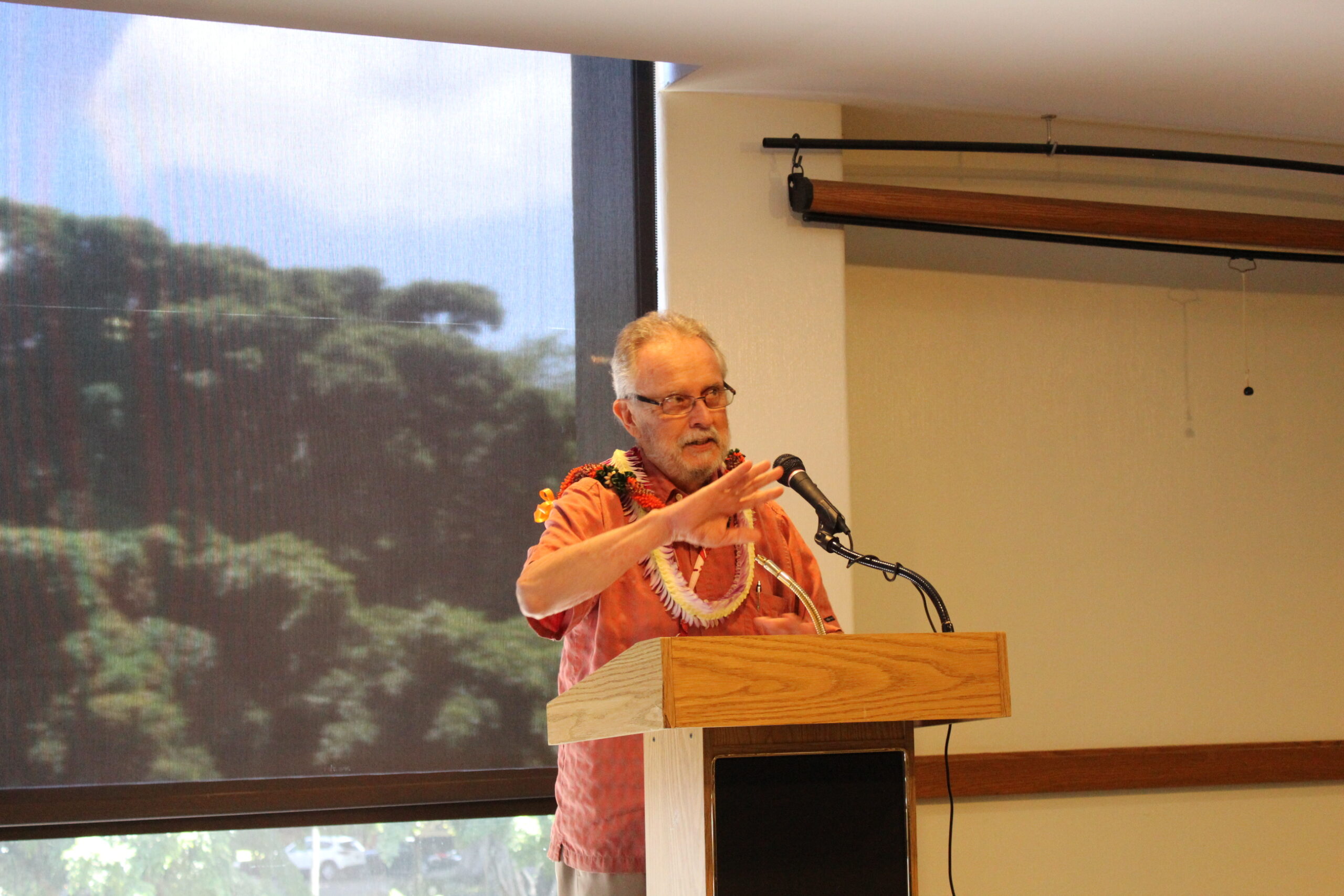
Throughout my doctoral studies, I served as President of our UH chapter of Phi Alpha Theta (Alpha Beta Epsilon), and when I finally got that coveted PhD., I served as a faculty advisor and mentor for our chapter. All through those years, I approached Dr. Chappell for advice and help on every regional conference we organized. When both Dr. Chappell and Dr. Hanlon retired from teaching in 2018, it seemed only fitting that we create a paper prize for the Annual Hawaiʻi Regional Phi Alpha Theta conference which acknowledged their extraordinary careers. We called it the Oceania History Prize, awarded to honor the longtime work of our colleagues and PAT supporters Dr. David Chappell and Dr. David Hanlon. The prize is intended to recognize and encourage research into Pacific Islands’ pasts that uses a comparative, transnational or ethnographic approach. I was privileged to announce this award at the 2018 regional conference when both Jack and Wendy Tunstall, (former Executive Directors of Phi Alpha Theta), had come to visit Hawaiʻi and witness for themselves the incredible work of our students and mentors. We were to find out that Dr. Chappell had submitted papers to Phi Alpha Theta regionals himself many years before. In a recent book, Serendipity: Experience of Pacific Historians (Brij V. Lal ed., University of Hawaiʻi Press, 2024), Dr. Chappell recounts, “While a doctoral student, I had already achieved success in academic publishing that had eluded me so far in creative writing. I won prizes presenting papers at Phi Alpha Theta history honor society graduate student conferences, and revised some for submission, beginning with a comparison of nuclear issues in US Micronesia and French Polynesia that appeared in a short-lived graduate student journal.” What a great tribute to the power of Phi Alpha Theta!
But my journey with my “rock star” historian did not stop there. A year later when I prepared to defend my dissertation in Spring 2019, Dr. Chappell asked to read the final draft of my dissertation. He was not required to read it; he wanted to read it. He was already retired and yet he showed his faith in me and read all 339 pages of the dissertation. Moreover, he sent back five pages of notes (single-spaced!) to help me make some final edits before I faced my doctoral committee. He attended the defense as well and I could not have been more grateful in those nerve-wracking moments to see him across the table, knowing he was that same “rock star” historian who answered my email a decade before. I am still learning from Dr. Chappell. This is the greatest gift of our Phi Alpha Theta mentors; the true “rock star” historians sing to us for the rest of our lives and create the next mentors.
Mahalo nui loa, Dr. Chappell.
Tribute written by Shirley Buchanan, Alpha-Beta-Epsilon Chapter, University of Hawaiʻi at Mānoa
Professor Emeritus David A. Chappell passed away on May 14, 2026, following a battle with lymphoma.
Your gift helps fund scholarships and research grants for history students
The Historian welcomes manuscripts submitted from throughout the world, and from all regional, temporal and thematic fields of history. Submissions should be of interest to a wide readership. Manuscripts that have been published elsewhere, that are being considered for publication elsewhere, or that present themselves as op-ed pieces, will not be considered.
Manuscripts should normally be between 6,000 and 8,000 words, exclusive of footnotes. They are to be double-spaced, with one-inch margins (right margin unjustified). Submissions are expected to meet the highest standards of academic quality, have an original point, be in dialogue with all the relevant literature, and either be based on new source material, or constitute an exhaustive and critical overview of the historiography of a particular topic. They need to be written in flawless English. Please Americanize the English—e.g., “labor” rather than “labour,” “defense” rather than “defence,” “analyze” instead of “analyse”—except if the word(s) in question are part of a quote or title. Citations must be accurate and precise, indicating the sources of the argumentation, and must conform to The Chicago Manual of Style, latest edition.
We only publish original articles and do not publish translations of essays published previously in another language.
The Historian recognizes the expanding use of artificial intelligence (AI) by authors for their research. It is important, however, for those who submit their work for review to distinguish between AI used for assistive versus generative purposes, as well as what authors must disclose.
“Assistive” AI refers to tools that make suggestions to improve one’s work, including grammar, spelling, and translating one’s words into English. Authors need not disclose the use of AI for such purposes.
“Generative” AI refers to tools—among them large language models (LLMs), machine learning, and similar programs—that rewrite large portions of one’s manuscript; that produce source material or images; or that affect the ideas or conclusions presented. According to the policy of Taylor and Francis, which publishes The Historian, “Authors must clearly acknowledge within [an] article…any use of Generative AI tools through a statement that includes: the full name of the tool used (with version number), how it was used and the reason for use.” For The Historian, that acknowledgement must appear in a footnote. It is important to note that The Historian strongly discourages the use of AI for generative purposes and may disqualify a submission on that rationale alone.
Should the editor discover that a work submitted used any generative AI tools without disclosure, they reserve the right to reject that work at any point during the process of publication.
Authors are strongly encouraged to review Taylor and Francis’ AI policy, which can be found here: https://taylorandfrancis.com/our-policies/ai-policy/.
If a submission complies with the above requirements, usually specialists in fields relevant to the topic and holding the doctoral degree are selected to review the submission anonymously. The substance of these reports will be relayed to the author by the editor. On the basis of reviewer reports, the editor decides whether to proceed with publishing.
If your manuscript complies with the above requirements, please send one copy, in MSWord, as an e-mail attachment to historianeditor@phialphatheta.org. The author’s name should be included on the title page only. Authors should also send a one-hundred-word summary abstract of the article and their e-mail address(es).
Evaluation of manuscripts generally requires four to six months. We encourage inclusion of photographs, maps, and other illustrative material, which must be provided in camera-ready form, with authorization from copyright holders for these materials’ reproduction in The Historian. Manuscripts are edited for organization, clarity, and consistency.
Authors with any questions about The Historian’s policies are encouraged to contact the editor at historianeditor@phialphatheta.org.
Prefer a copy to keep? Download the full policy.
Download Policy (.odt)