
From One Classroom to 970+ Chapters: A Century of Academic Excellence
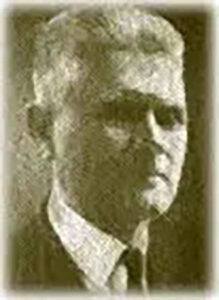
Nels Andrew N. Cleven established the National Honor Society in History, Phi Alpha Theta, at the University of Arkansas on March 17, 1921. Nels Andrew Nelson Cleven was born on December 21, 1874 in Lake Mills, Iowa. He began his teaching career in public schools in 1893 before receiving his bachelor’s degree (Ph.B and Litt) from the University of Chicago in 1900. Cleven earned his Ph.D from the University of Chicago in 1913, and taught at San Diego High School and Junior College until 1918. From 1918 to 1919 he worked as a research assistant for the War Trade Board’s Bureau of Research and Statistics in Washington, D.C.
In September 1919, Dr. Cleven moved to Fayetteville after accepting an assistant professorship from Dr. David Yancey Thomas, Head of the Department of History and Political Science at the University of Arkansas. Dr. Cleven and his wife Hilda soon found Fayetteville and the unique region of the Ozarks to their liking. They frequently volunteered the social activities of campus fraternities and sororities, organizations for which Dr. Cleven previously had little regard. These gatherings would inspire what he termed “the Phi Alpha Theta idea.”
The possibility of “diffusing information through socialized channels,” he wrote later, “was due to the kindly cooperation of my students in Arkansas.” He came to regard fraternities as “an essential spirit of the age – watchers at the Truth in History.” Such societies were sometimes “recruited and disciplined through noble principles” and “Despite the rational proliferation of social and professional fraternities during this period, he discovered there were no societies in History, a deficiency he was determined to remedy. In his mind, he envisioned a secret fraternity open to women as well as men, which would embrace the “active History of Mankind.” By chance, a painting depicting ancient Athens and featuring a red-robed Sea of Divinity hung on the wall of his classroom. The red became the central symbol for the History fraternity.
On March 14, 1921, Dr. Cleven presided over a meeting in his classroom with a group of History students. Those present voted to create the University Historical Society. Officers were elected and Constitutional, Programs, and Membership committees were appointed. Even though Dr. Cleven regarded this meeting as the anniversary date for the founding of Phi Alpha Theta, it was not until a month later that the name Phi Alpha Theta was formally adopted.
Since its inauguration in 1921, Phi Alpha Theta has grown to more than nine hundred chapters in all fifty states, more than any other accredited four-year college honor society. The total number of initiates since its inception exceeds 500,000 nationwide.
In 1996, Phi Alpha Theta received recognition as a non-profit 501(c)(3) organization. Contributions to our society are tax-deductible as allowed by law.
We are a nationally certified academic honor society for colleges and universities whose mission is to promote the study of History through the encouragement of research, good teaching, publication, and the exchange of learning and ideas among Historians. We seek to bring students, teachers and writers of History together for intellectual and social exchanges, which promote and assist Historical research and publication by our members in a variety of ways.
Your gift helps fund scholarships and research grants for history students
The Historian welcomes manuscripts submitted from throughout the world, and from all regional, temporal and thematic fields of history. Submissions should be of interest to a wide readership. Manuscripts that have been published elsewhere, that are being considered for publication elsewhere, or that present themselves as op-ed pieces, will not be considered.
Manuscripts should normally be between 6,000 and 8,000 words, exclusive of footnotes. They are to be double-spaced, with one-inch margins (right margin unjustified). Submissions are expected to meet the highest standards of academic quality, have an original point, be in dialogue with all the relevant literature, and either be based on new source material, or constitute an exhaustive and critical overview of the historiography of a particular topic. They need to be written in flawless English. Please Americanize the English—e.g., “labor” rather than “labour,” “defense” rather than “defence,” “analyze” instead of “analyse”—except if the word(s) in question are part of a quote or title. Citations must be accurate and precise, indicating the sources of the argumentation, and must conform to The Chicago Manual of Style, latest edition.
We only publish original articles and do not publish translations of essays published previously in another language.
The Historian recognizes the expanding use of artificial intelligence (AI) by authors for their research. It is important, however, for those who submit their work for review to distinguish between AI used for assistive versus generative purposes, as well as what authors must disclose.
“Assistive” AI refers to tools that make suggestions to improve one’s work, including grammar, spelling, and translating one’s words into English. Authors need not disclose the use of AI for such purposes.
“Generative” AI refers to tools—among them large language models (LLMs), machine learning, and similar programs—that rewrite large portions of one’s manuscript; that produce source material or images; or that affect the ideas or conclusions presented. According to the policy of Taylor and Francis, which publishes The Historian, “Authors must clearly acknowledge within [an] article…any use of Generative AI tools through a statement that includes: the full name of the tool used (with version number), how it was used and the reason for use.” For The Historian, that acknowledgement must appear in a footnote. It is important to note that The Historian strongly discourages the use of AI for generative purposes and may disqualify a submission on that rationale alone.
Should the editor discover that a work submitted used any generative AI tools without disclosure, they reserve the right to reject that work at any point during the process of publication.
Authors are strongly encouraged to review Taylor and Francis’ AI policy, which can be found here: https://taylorandfrancis.com/our-policies/ai-policy/.
If a submission complies with the above requirements, usually specialists in fields relevant to the topic and holding the doctoral degree are selected to review the submission anonymously. The substance of these reports will be relayed to the author by the editor. On the basis of reviewer reports, the editor decides whether to proceed with publishing.
If your manuscript complies with the above requirements, please send one copy, in MSWord, as an e-mail attachment to historianeditor@phialphatheta.org. The author’s name should be included on the title page only. Authors should also send a one-hundred-word summary abstract of the article and their e-mail address(es).
Evaluation of manuscripts generally requires four to six months. We encourage inclusion of photographs, maps, and other illustrative material, which must be provided in camera-ready form, with authorization from copyright holders for these materials’ reproduction in The Historian. Manuscripts are edited for organization, clarity, and consistency.
Authors with any questions about The Historian’s policies are encouraged to contact the editor at historianeditor@phialphatheta.org.
Prefer a copy to keep? Download the full policy.
Download Policy (.odt)